
A woman alone in Bari's fish market
/I love a fish market.
As a family, we seek out fish markets wherever we travel—from New York’s Chinatown to Genova to Bangkok. It is a slightly embarrassing fact that we have spent more time in the Rialto fish market than all Venetian museums and churches combined.
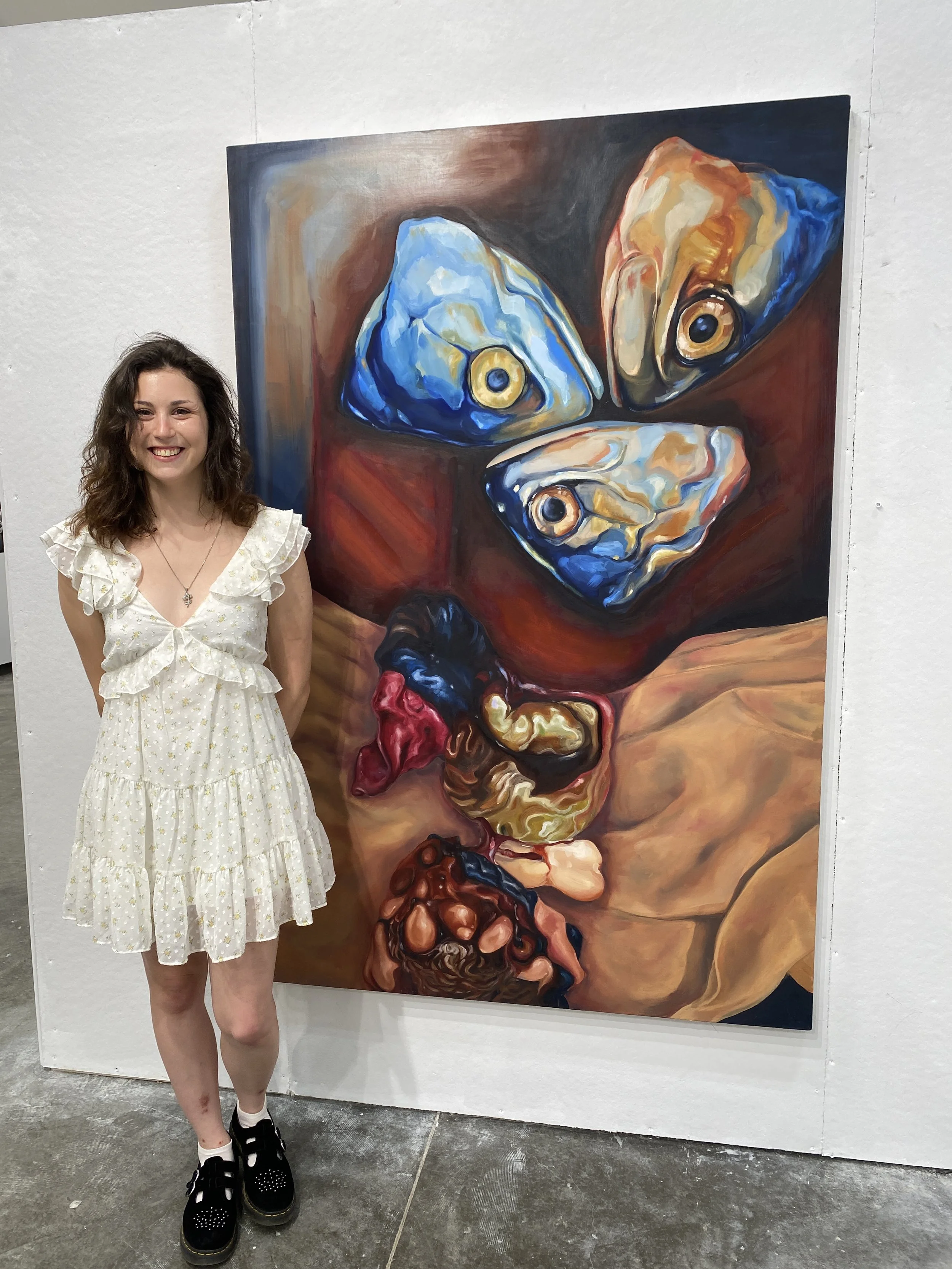
I never really thought about why until my daughter had a good three year run of what one might diagnose as a full-blown fish obsession. In her art program at Rice she went hard on fish wallpaper (made from a stamp she carved from an actual fish), oil paintings of fish draped in pearls like royalty, and little metal fish wearing kimonos fashioned from cat-treat wrappers. One professor gently suggested she consider another muse. In response, she painted a six-foot-tall canvas of mackerel heads.
Siena says fish live at a beguiling crossroads—grace and science, disgust and fascination, nature and food, men fishing and women cooking (you can see her collection of fish works here).
It’s nice when your child loves to paint what you love to photograph. And it turns out I’m not the only one providing her source material—she regularly receives photos of fish and fish markets from others who see all of it differently through the lens of her paintbrush.
So when I opened the “Map by City” app in Bari, Italy and noticed a fish market on the proposed walking tour, I slipped on my sandals.
I am a traveler who connects with a place by walking all over it, but particularly towards food and markets, which is why an app like “Map my City” is so valuable. I could wander around, pause at sights and learn about them via the app, all the while knowing a fish market lay just ahead.
Theoretically.
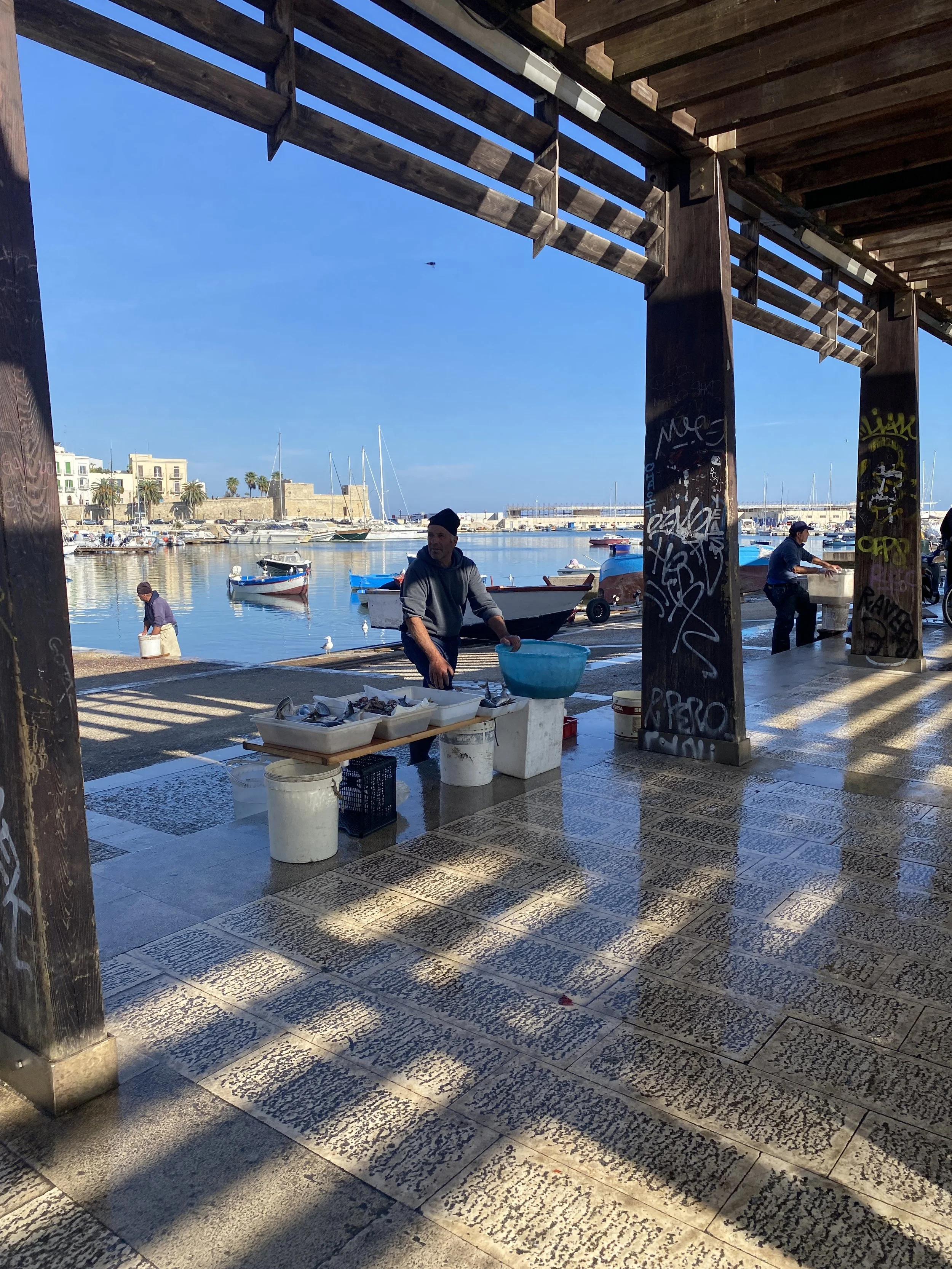
I mean, the app insisted I had arrived, but I saw no grand covered hall or Art Deco façade. Just a line of fishing boats parked along a jut of sidewalk into the sea. (Parked is obviously the wrong word, as is sidewalk, but as much as I’ve waded into the world of fish, the world of boats and their jargon remain a mystery.)
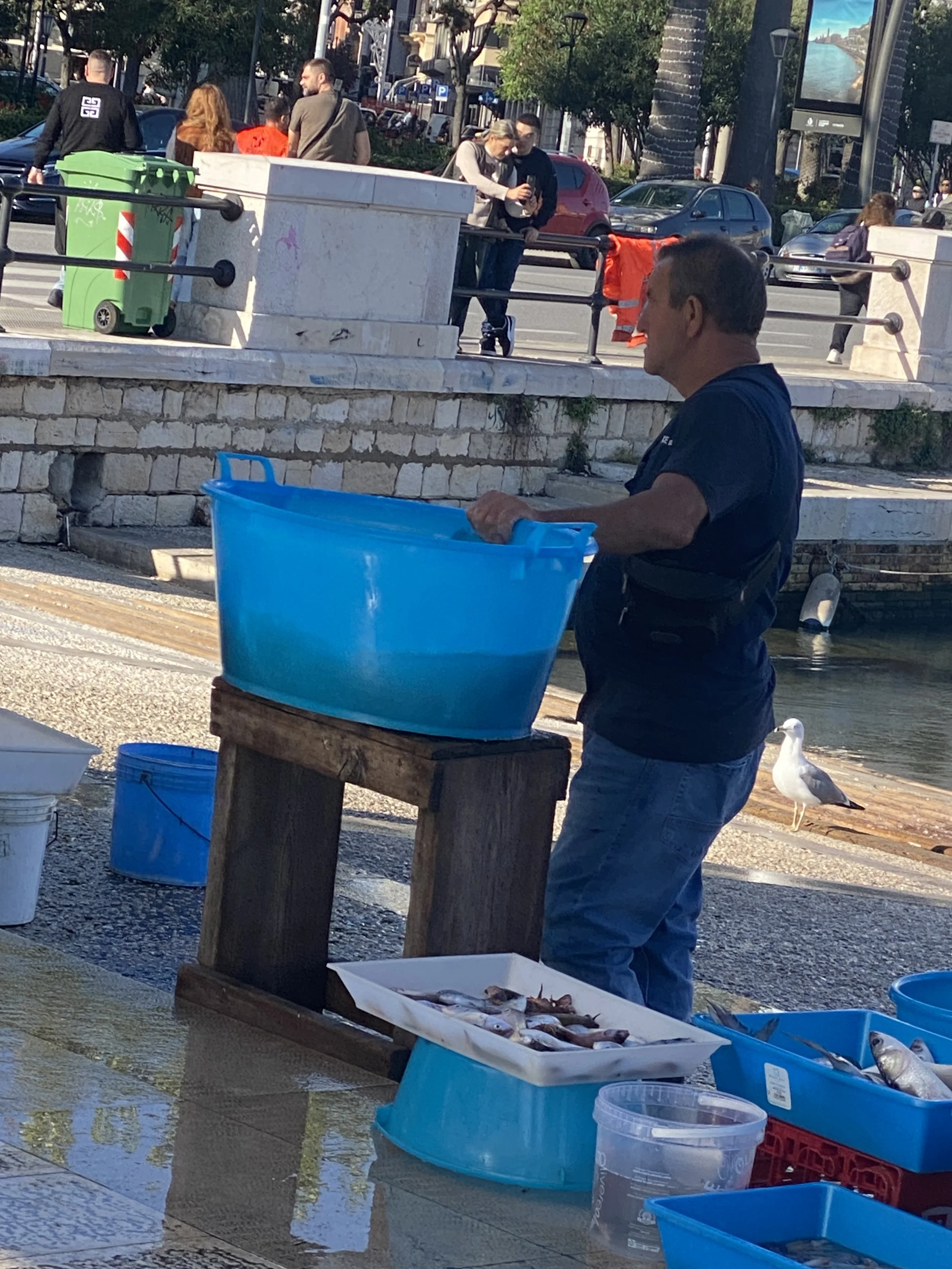
As I frowned, sure I must have gotten turned around, I noticed men—faces leathered, hands rough, bodies shaped by years on the water—relentless shaking large tubs of frothing seawater. One man per mooring, shaking and shaking, like an old-timey laundress.
Curiosity—and the promise of fish—lured me forward (see what I did there).
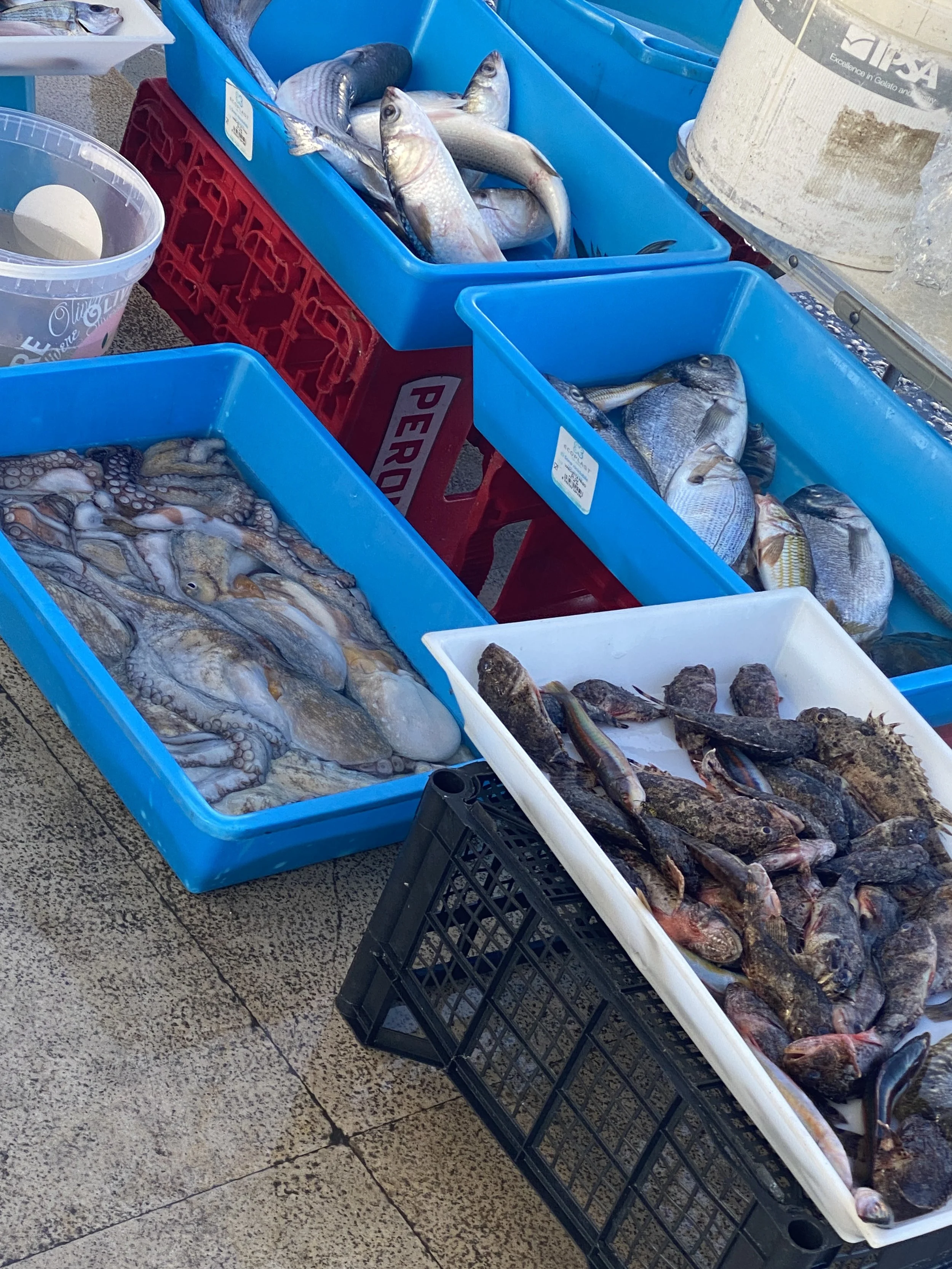
I watched as a fisherman plunged his arm into one of the frothy tubs and lift out an octopus.
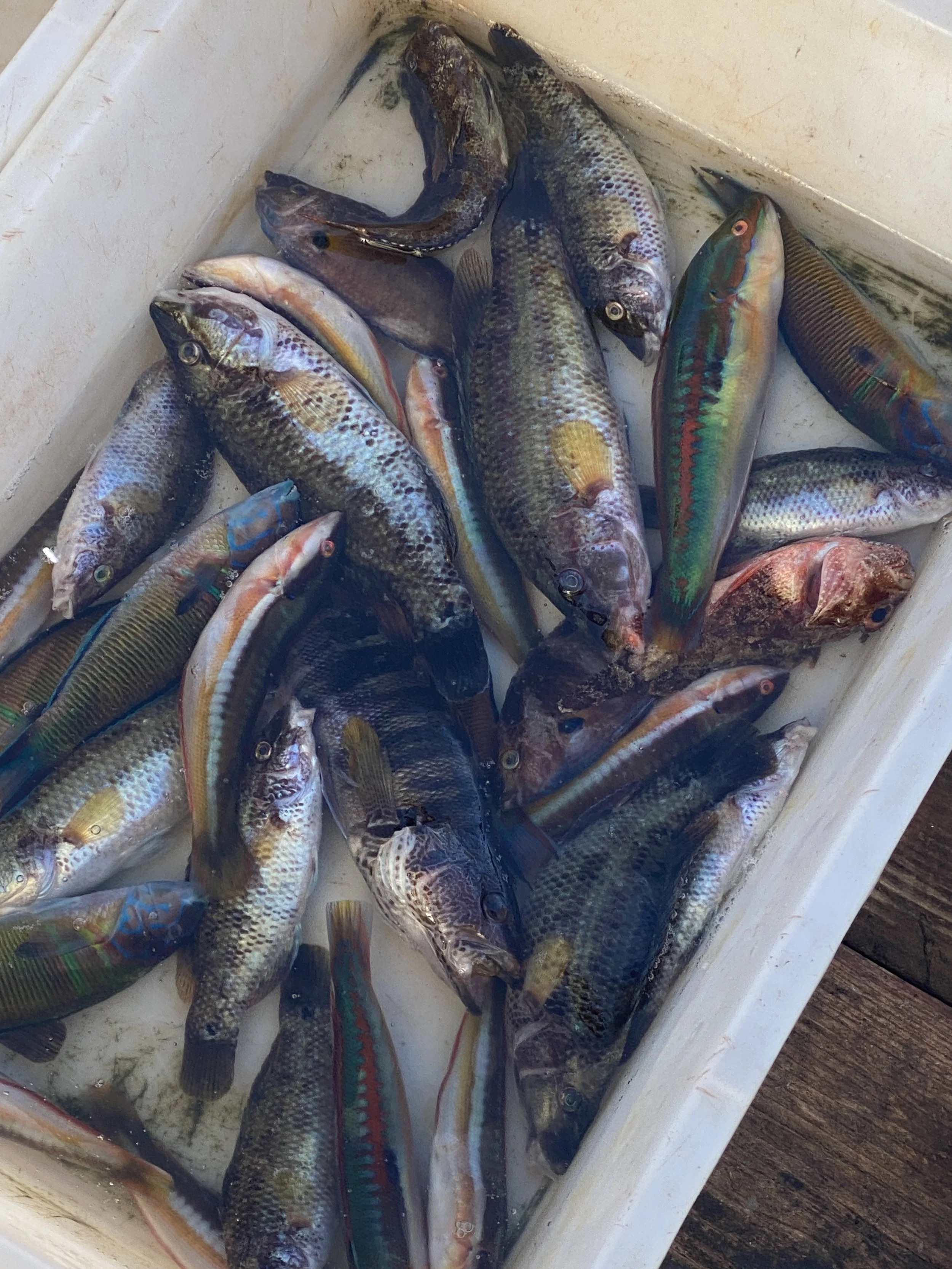
Once I knew what I was looking at, I saw them everywhere. Octopus in every rocking bin. Octopus in styrofoam boxes. Alongside more styrofoam boxes filled with what can only be described as a potpourri of fish—a sentence I never expected to write. It was a one fish, two fish, red fish, blue fish situation. When I sent my daughter this photo, she acted like I’d sent her an Amazon gift card with a lot of zeros.
The scene snapped into focus. This was not just a market but something closer to a sports bar for the Italian fisher set—minus the televisions and balls.
Briny air.
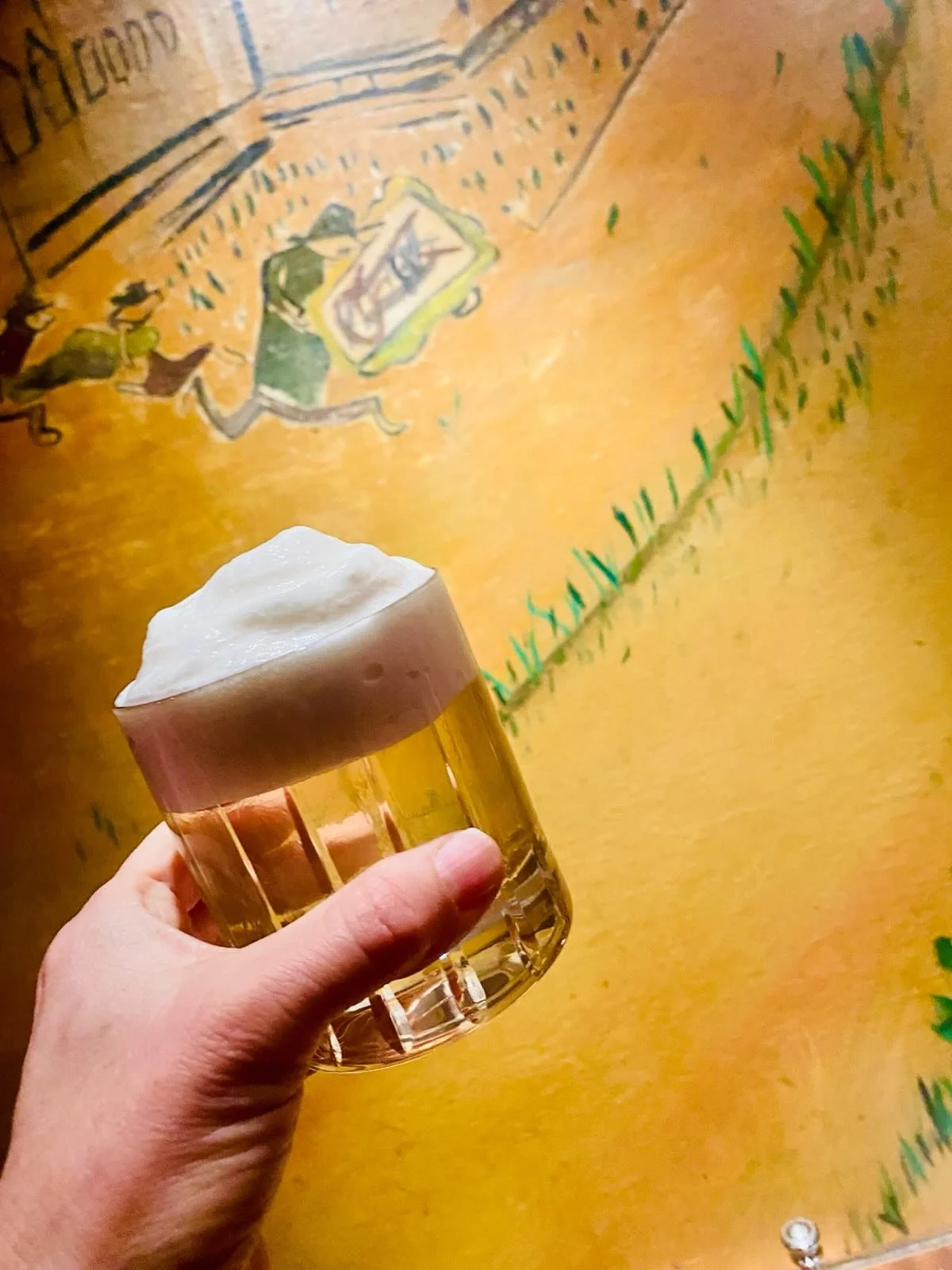
Waist-high tables where men leaned and drank beer—Peroni, apparently, makes an excellent breakfast.
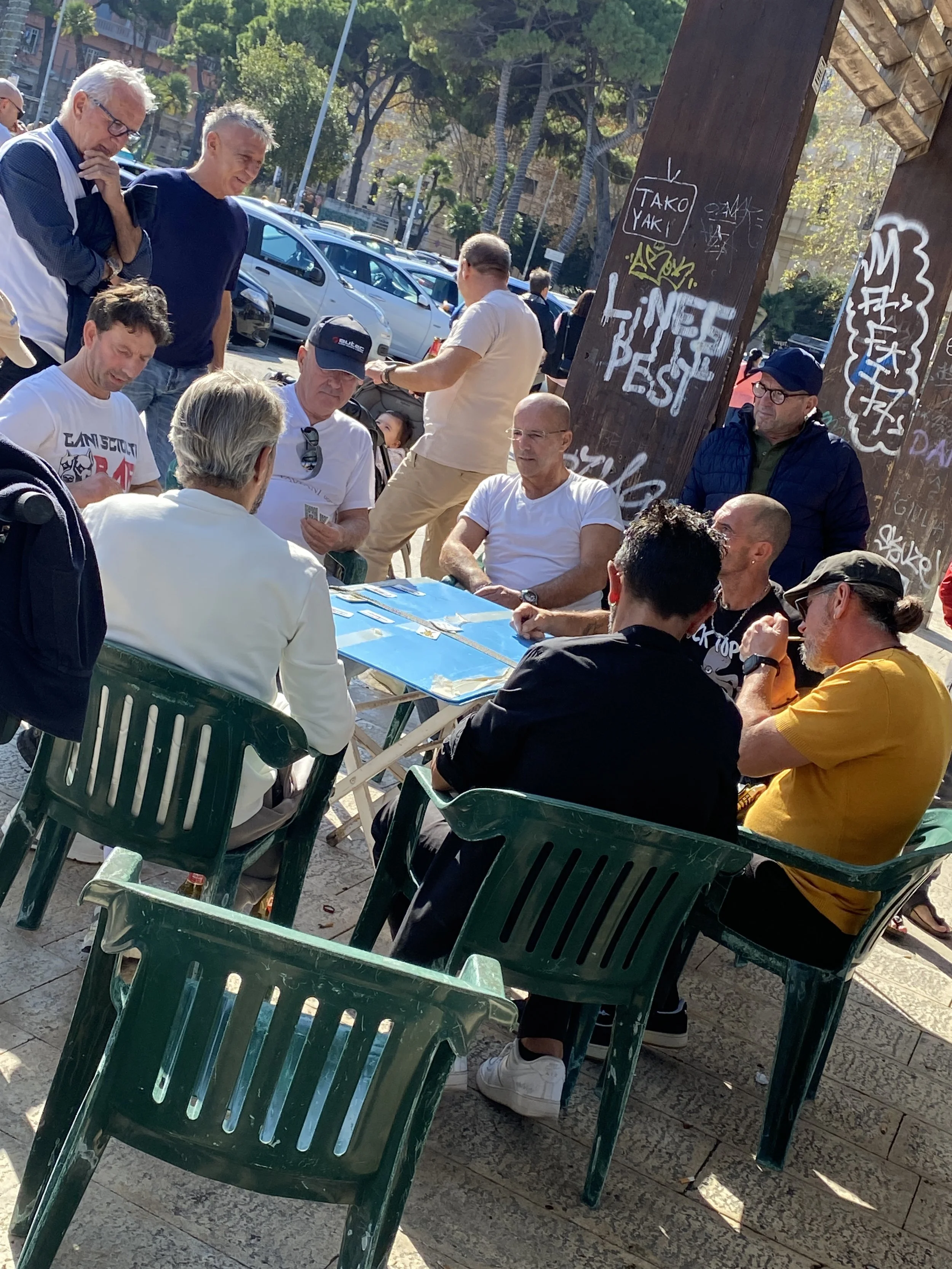
Wooden boards balanced on crates for scopa games. Not just old men playing, as I’d seen in other towns—these groups spanned generations.
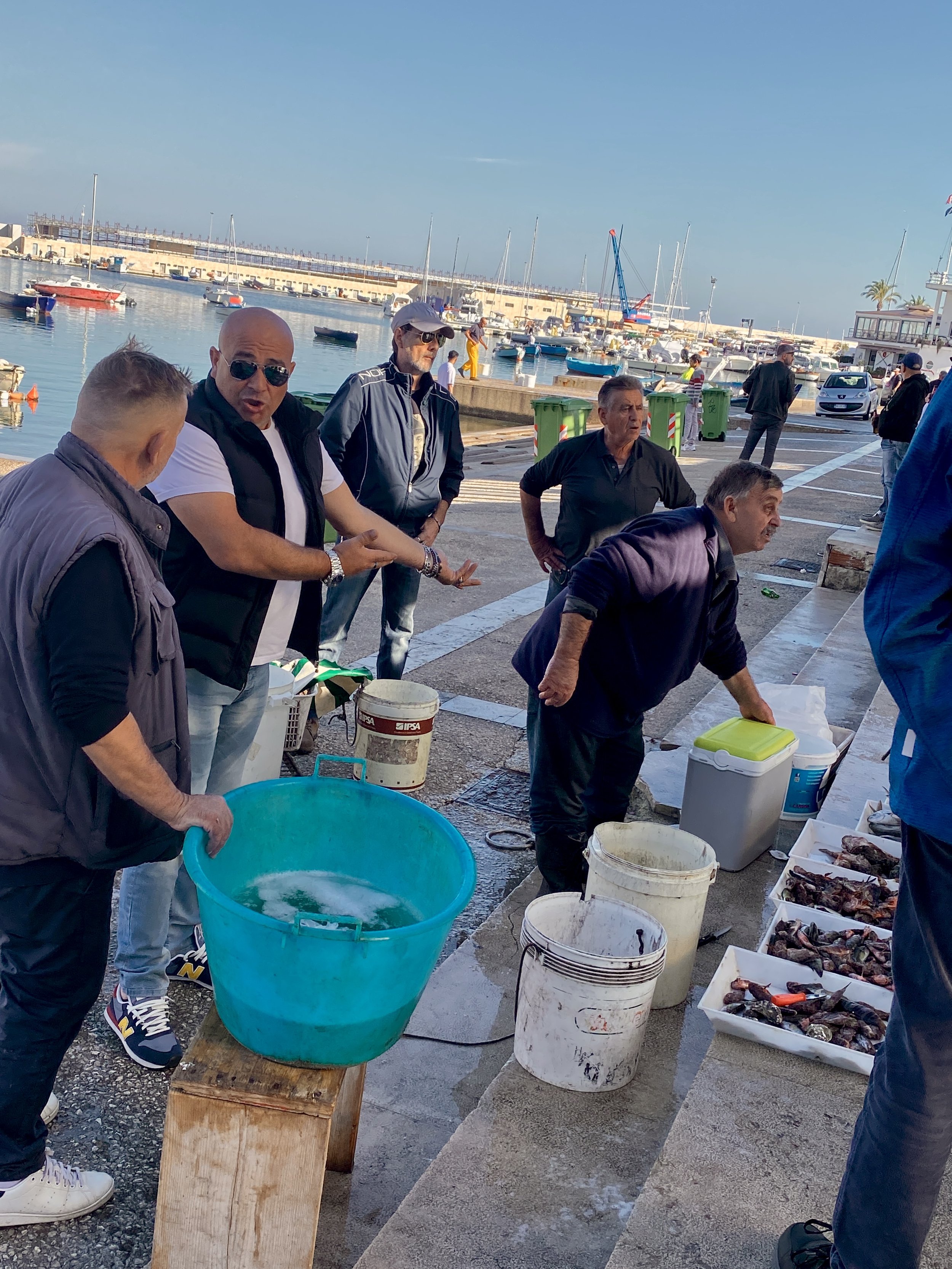
And not one group of card playing men, but many. Over time, the length of the market filled with multi-generational knots of men—young, old, and everything in between—knocking back beers, slapping cards down, guffawing and shouting.
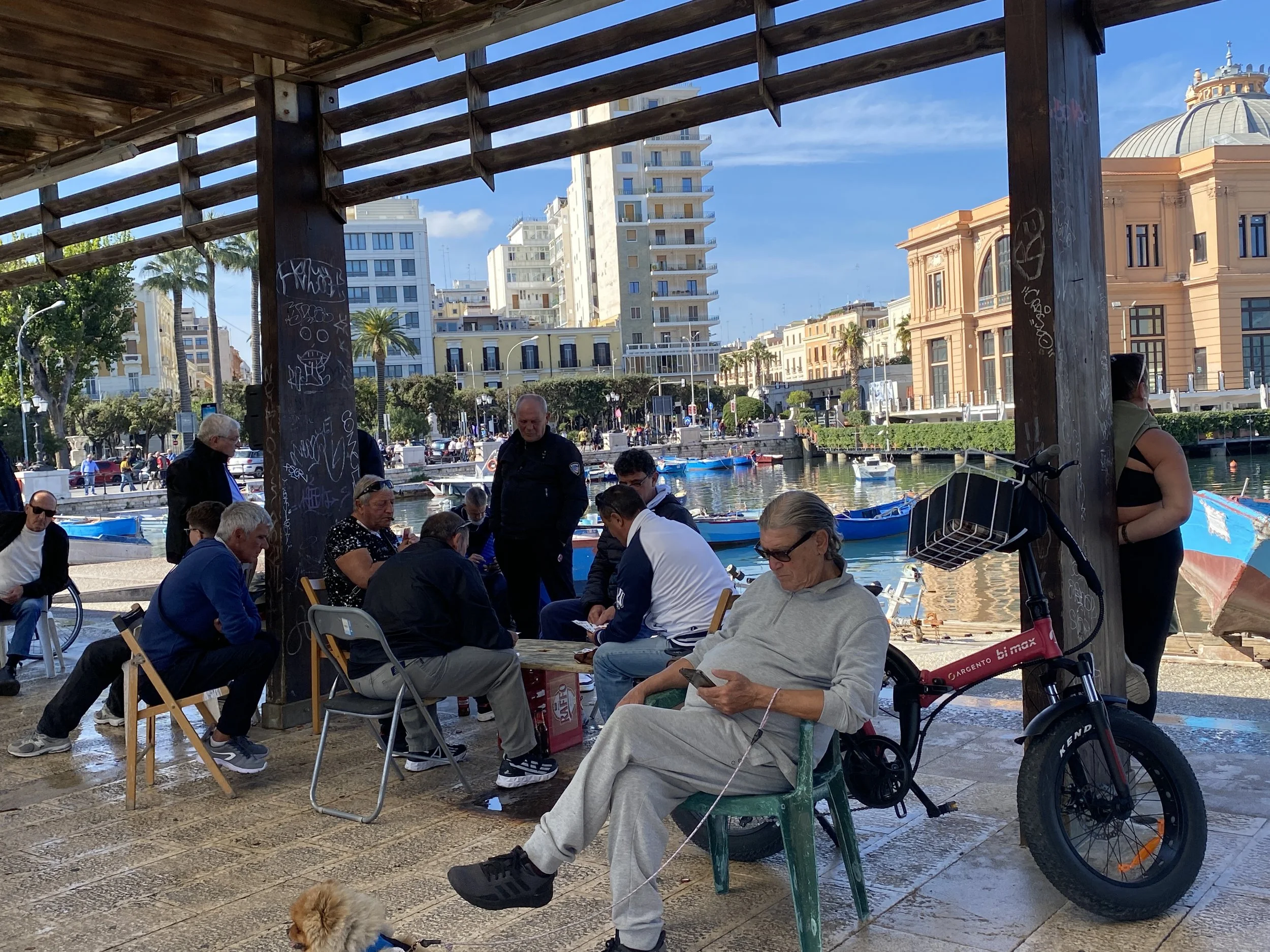
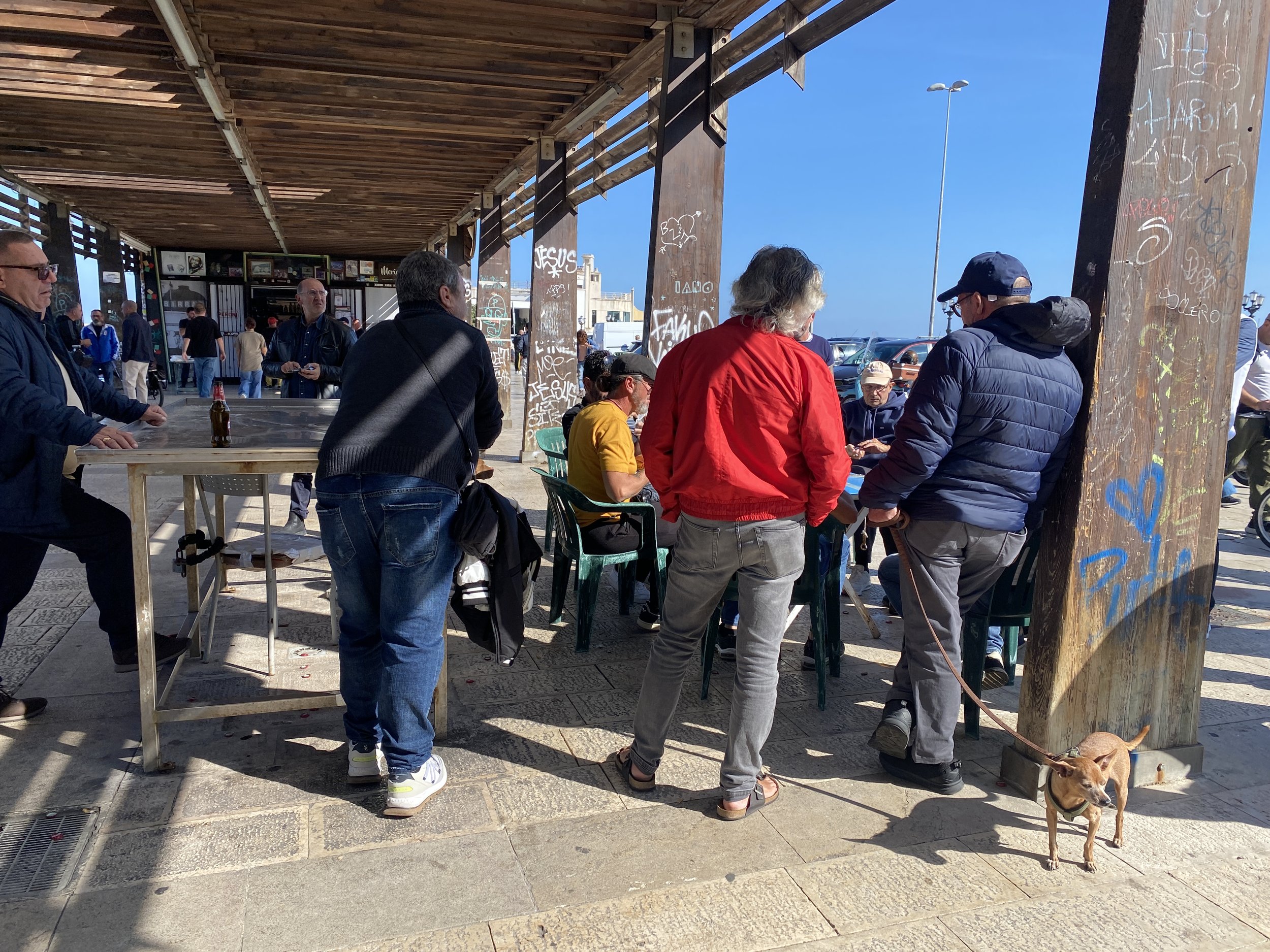
Later I learned that rocking octopus in seawater breaks down the proteins—hence the foam—crucial when you plan to eat octopus raw, as Bari prefers. Perhaps if I’d stayed longer, I would have seen those stainless-steel tables laid with quickly sliced octopus dressed only with lemon.
But I didn’t stay.
Women, I know you’ll understand this: there’s a moment when being alone in a male-dominated space stops feeling observational and starts feeling conspicuous.
That choice—to stay or to go, to linger or step away—is something solo travel sharpens. When you travel alone, there is no committee decision. There is only the act of tuning in and listening to the still small voice inside of you, then amplifying that quiet instinct into authority.
I left.
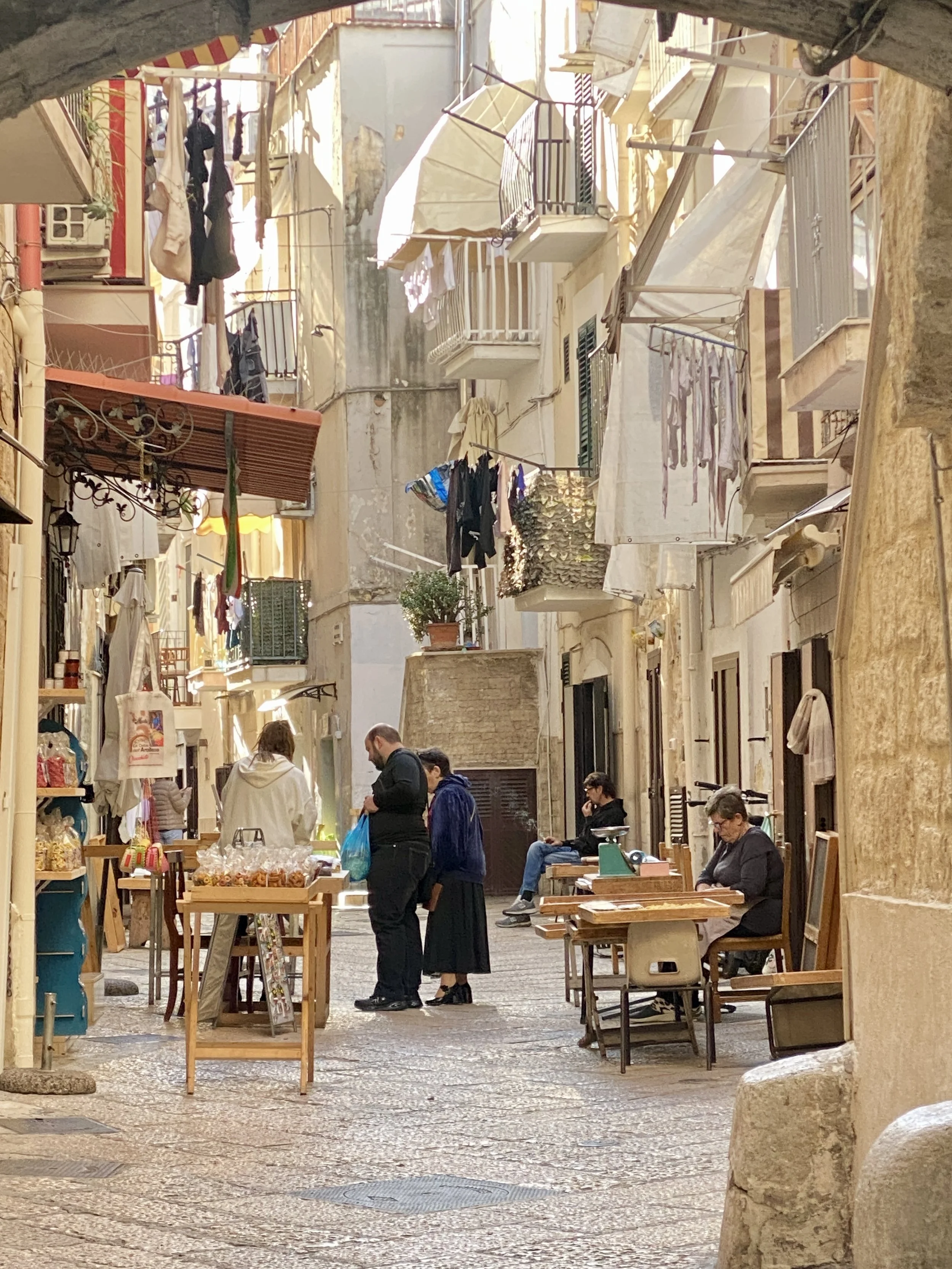
Luckily, Bari has charms enough that I’m perfectly content having missed my raw octopus initiation. No regrets. My still small voice, it knows.
In fact, it was that still small voice that led me to tack on a few days in Bari at the conclusion of my Book Club with a View tour (check out posts about that group in this post on Matera and this one on the roots of Puglia, and let me know if you want to join me in 2026 before the Tuscany/Umbria tour fills!).
The year before, I’d traveled solo in Paris where I spent a few painful hours and then a few glorious days. What matters here is not the pain but what followed: once I settled into solitude, I realized that solo travel is simply Travel, capital T. Intentional, pure adventure, unadulterated discovery.
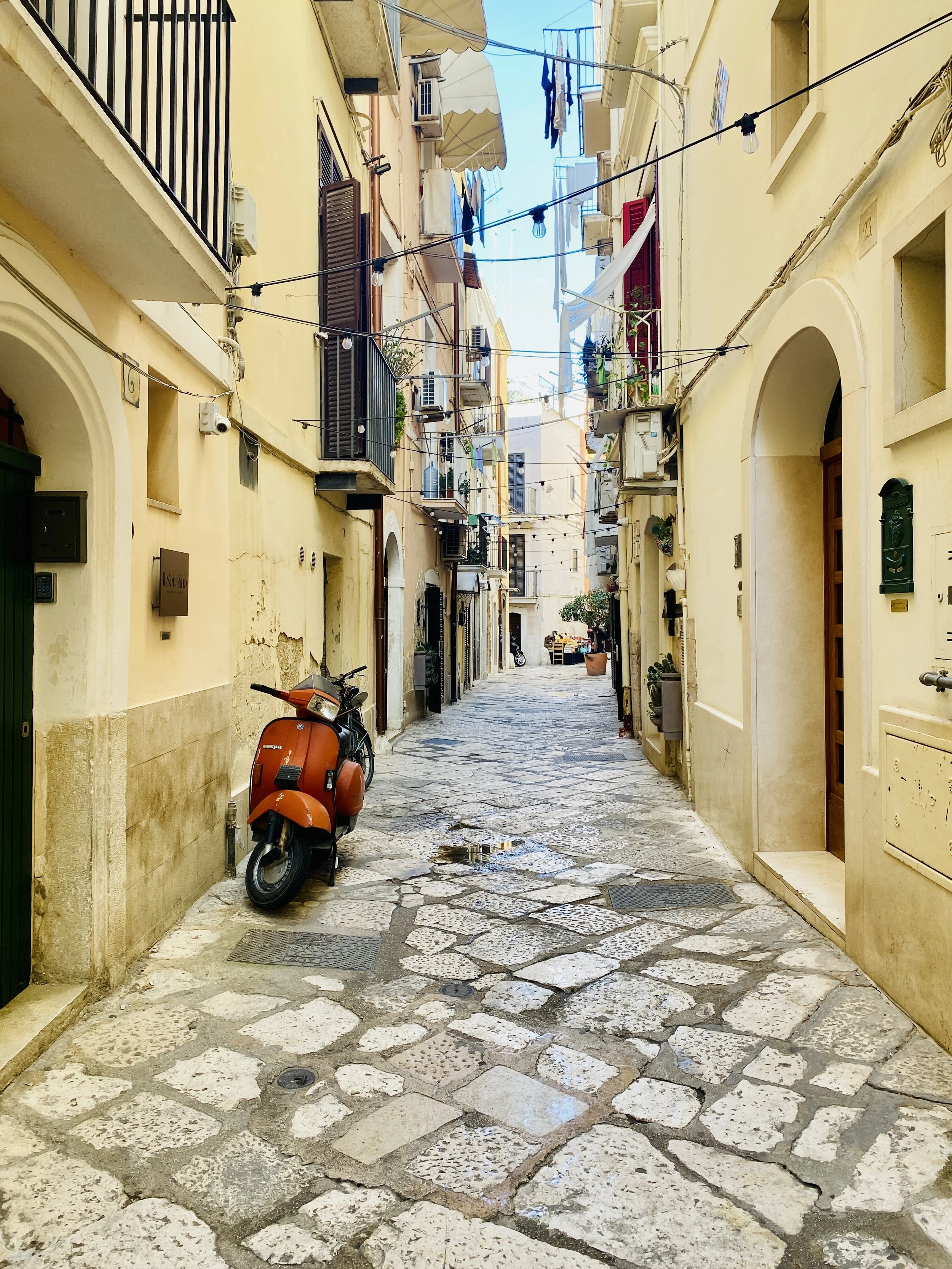
Alone, my attention tuned itself inward and outward at once—grounded in scent and sound and texture. By the end of that trip, sitting with oysters and champagne and my book, I wondered, quite seriously, Have I ever been this happy?
No shade to my family, whom I adore. But something about being alone quieted the low-level anxiety I wear like a constantly jingling charm bracelet. It evaporated, mist rising off the Seine.
I wondered, would that grounded joy translate to time alone in Italy?
Yes. Immediately. Undeniably.
Yes.
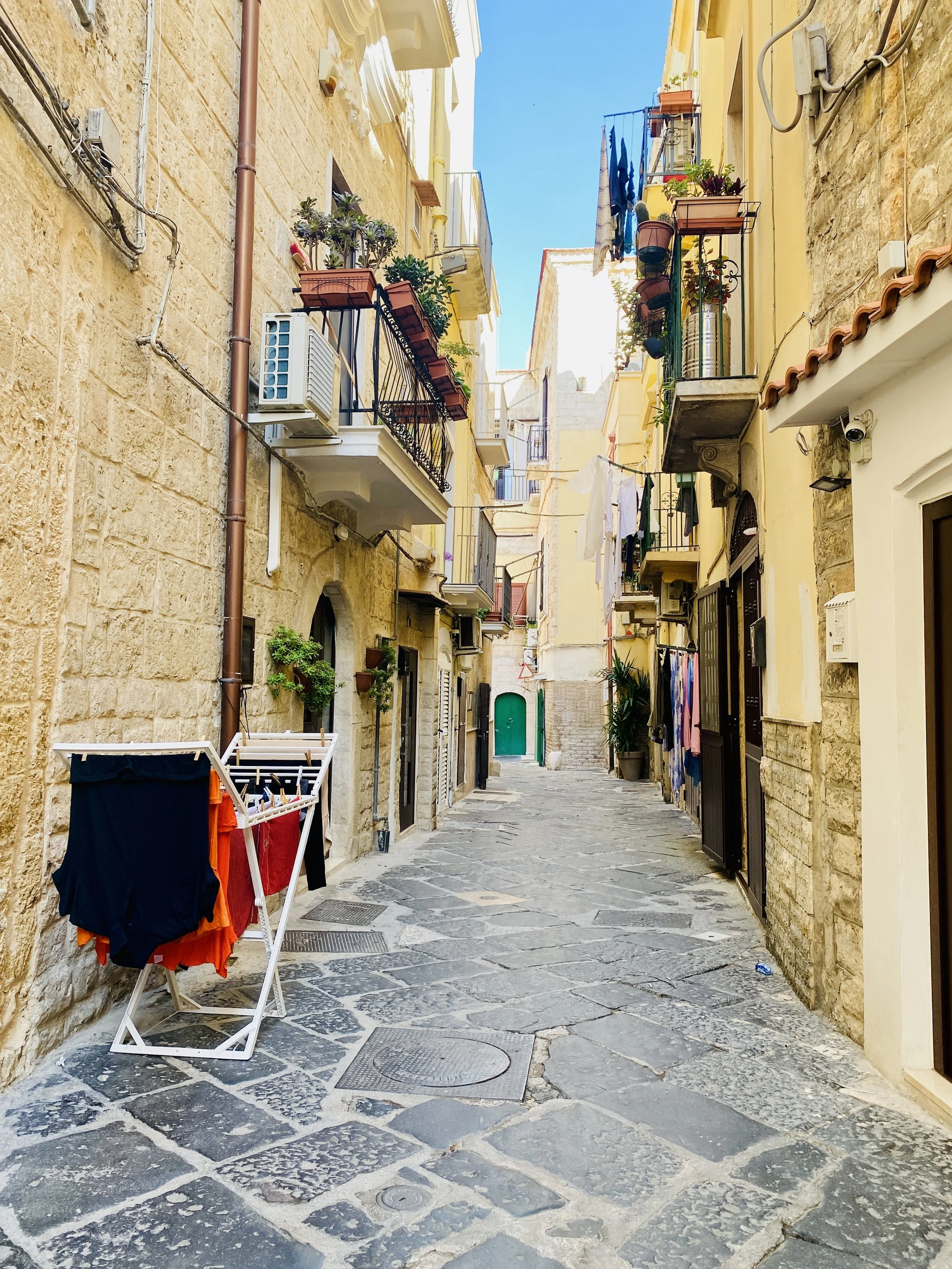
I guess that should be no surprise. After all, in Italy I’m at least able to communicate more sophisticated thinking than, “I’ll have a Kir, please.” Being more confident in my capability already reduces some solo nerves.
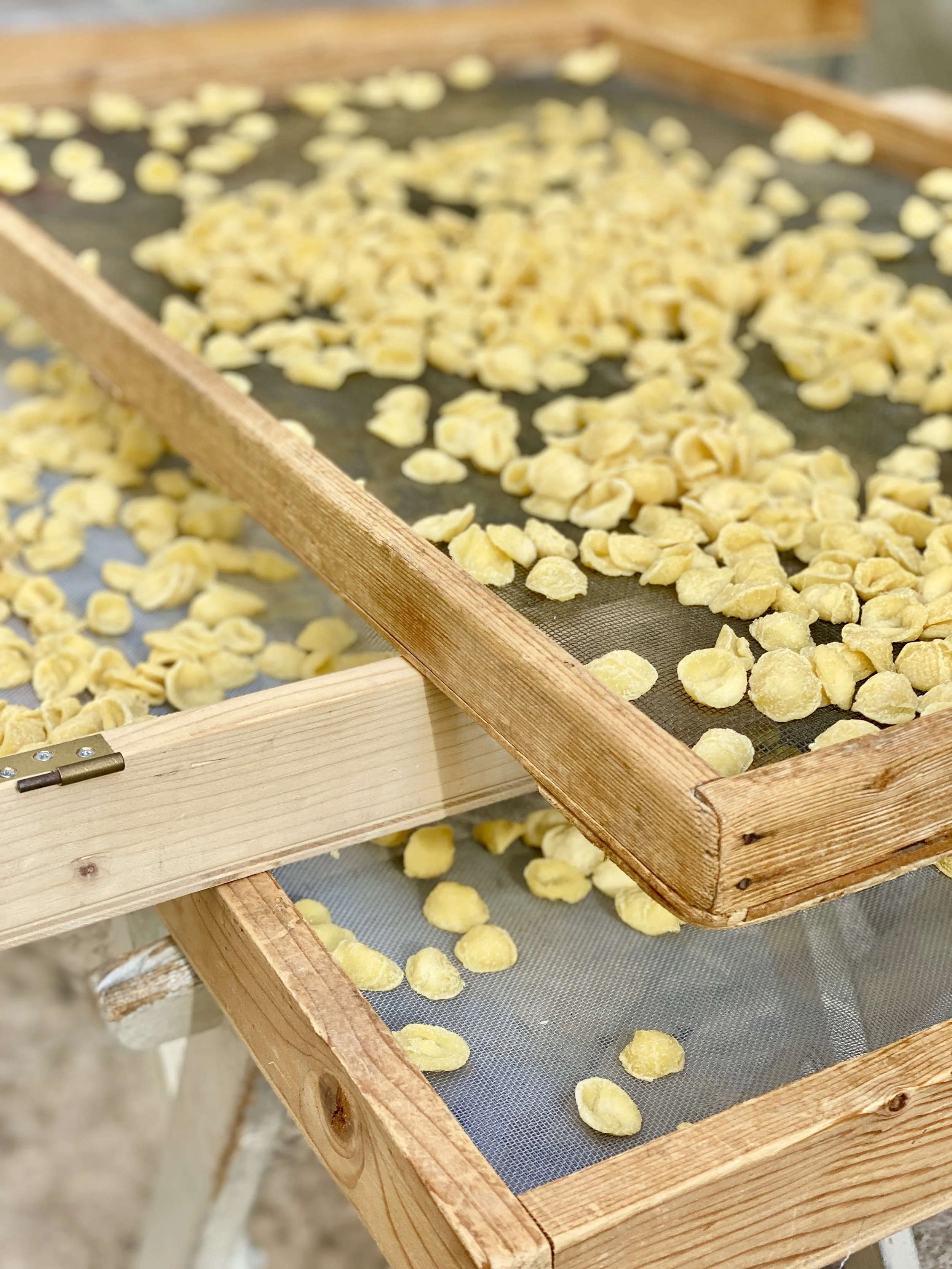
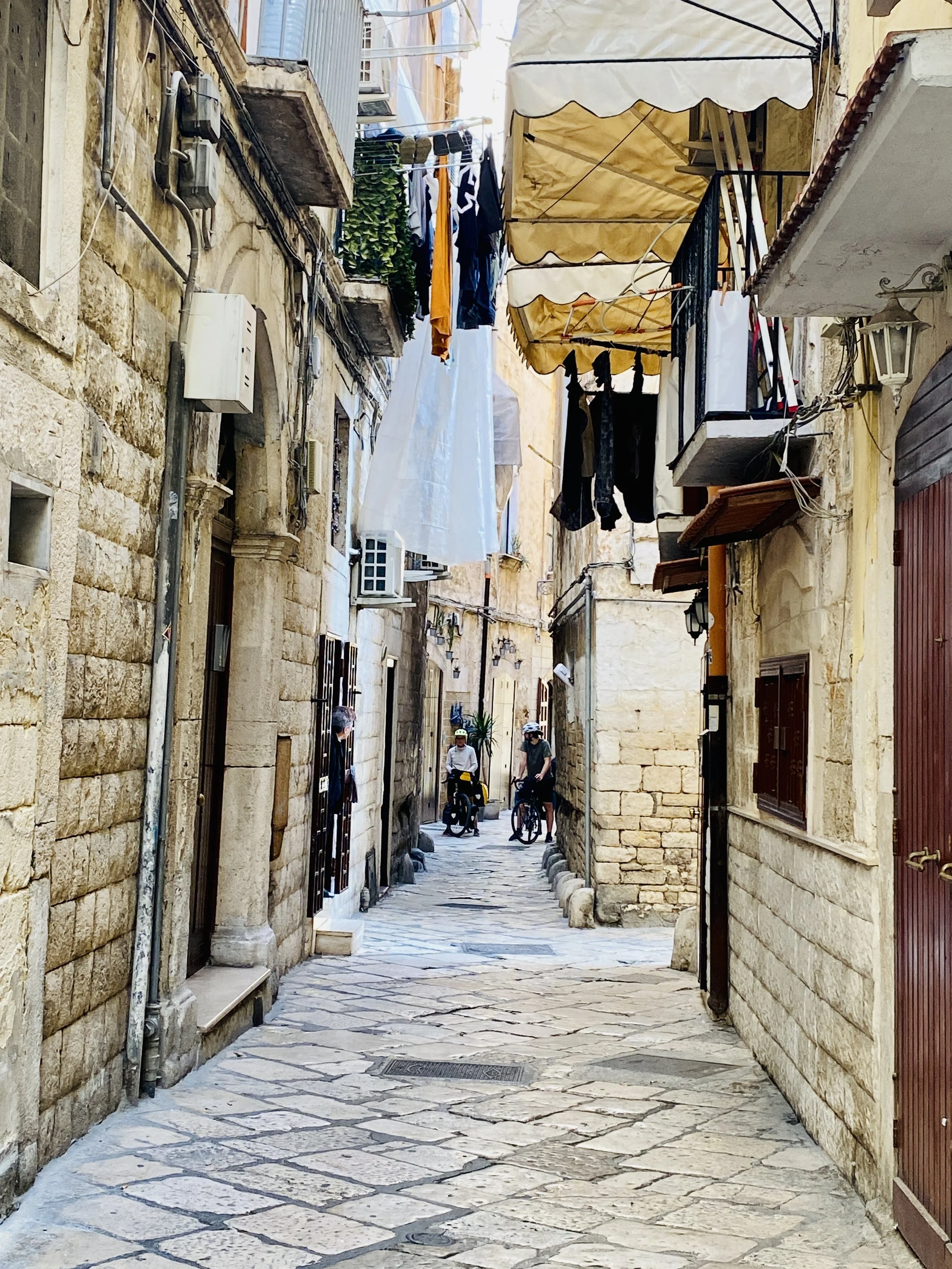
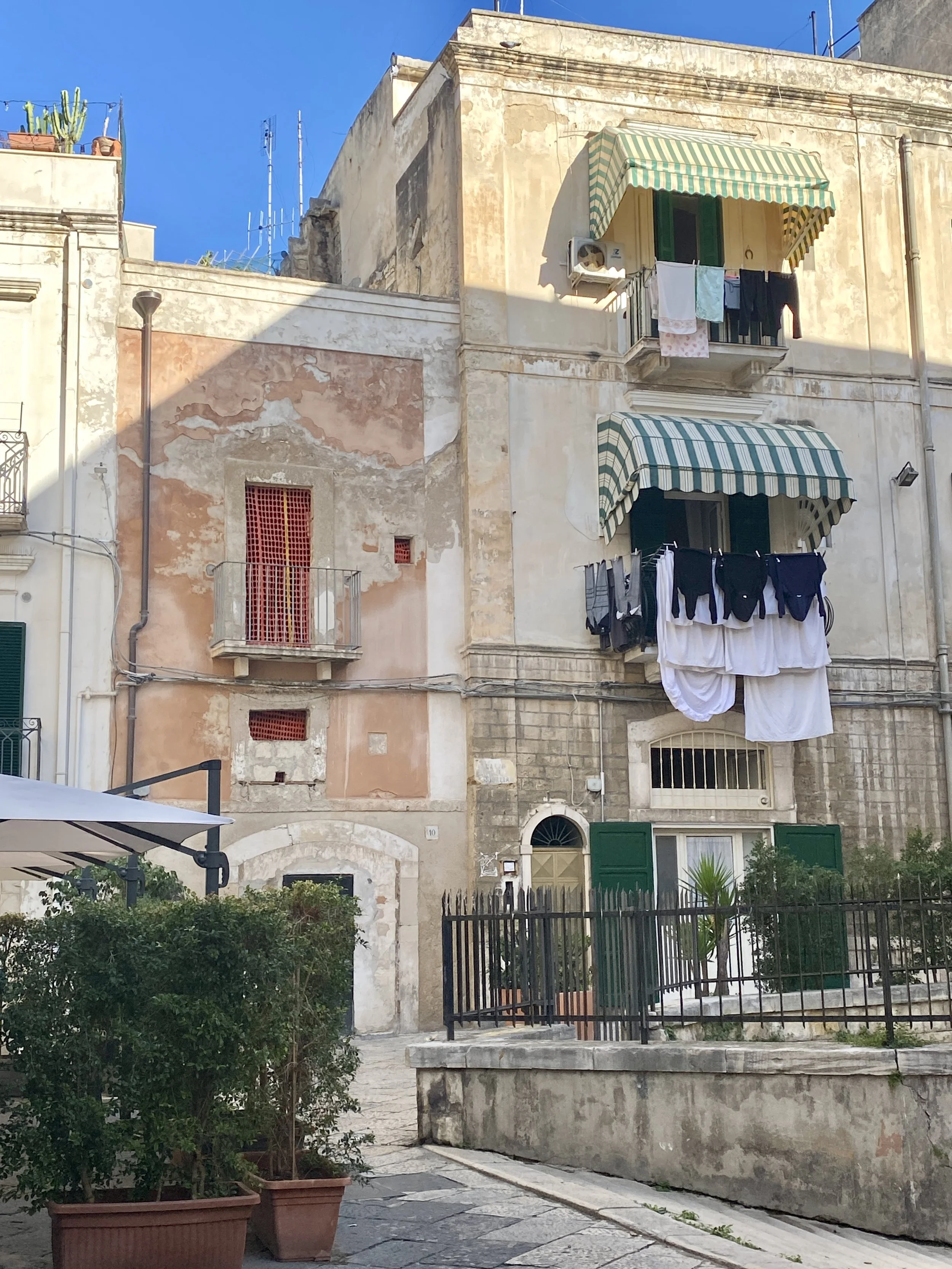
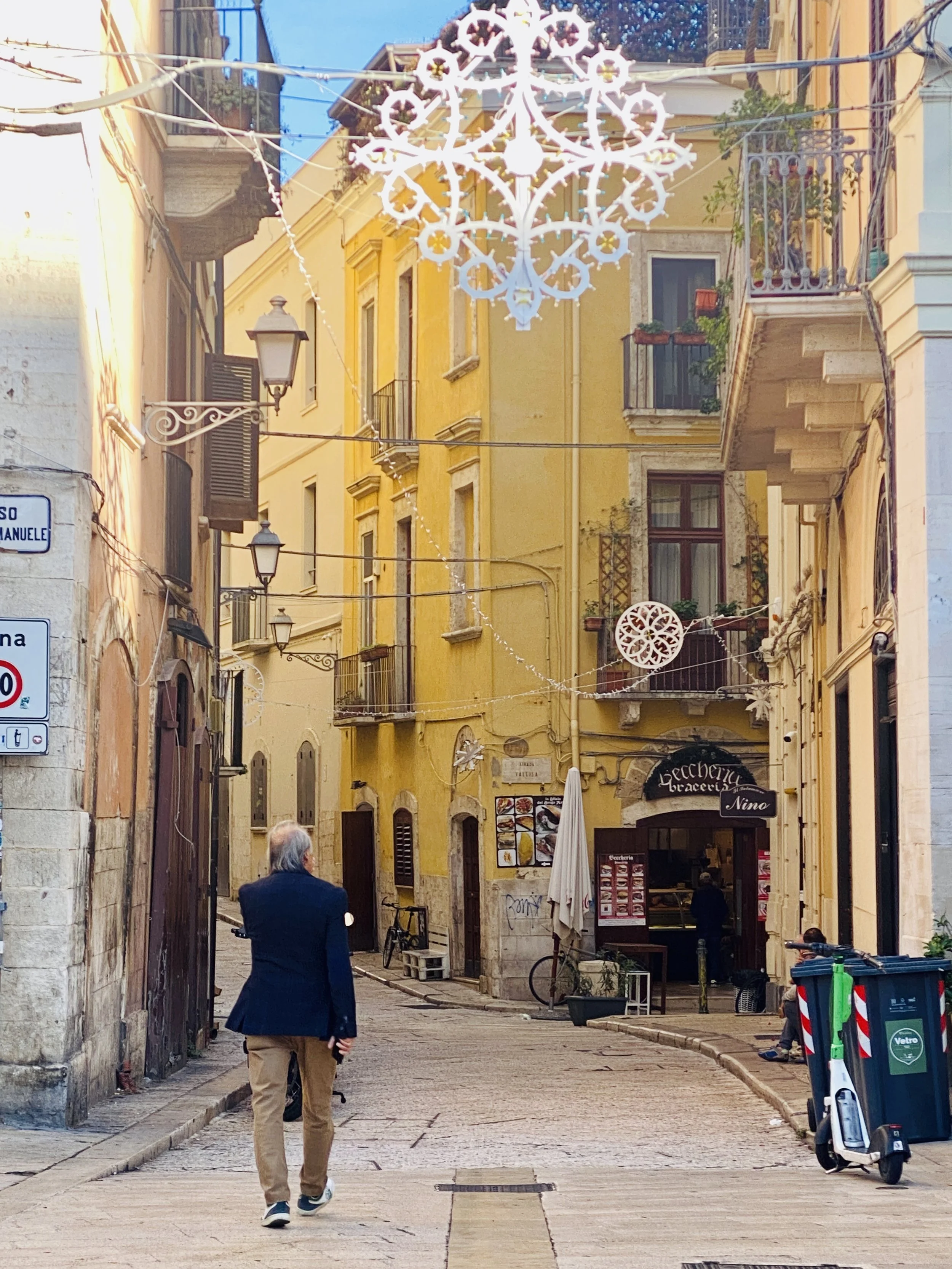
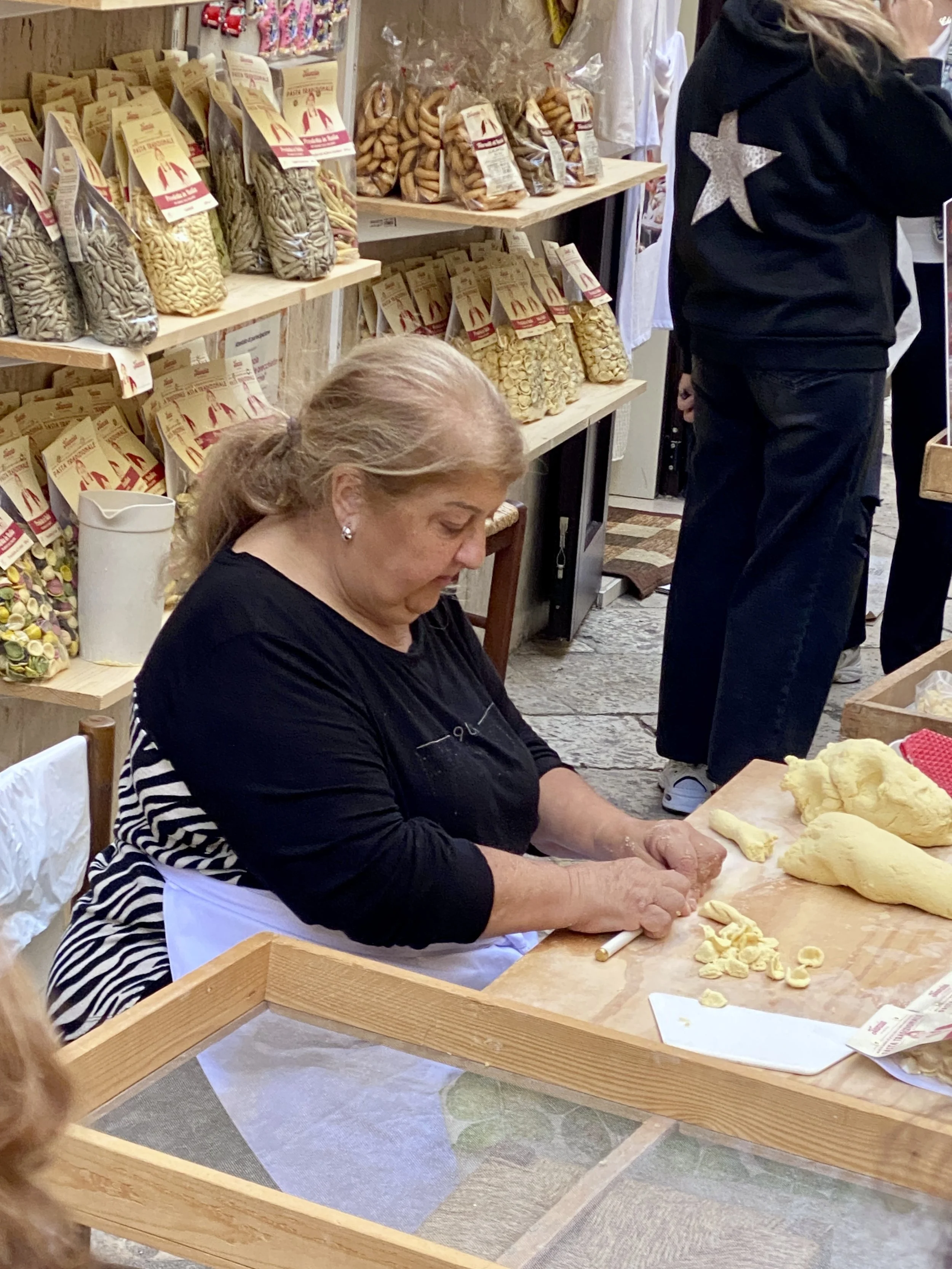
The bigger surprise was how Bari filled my senses. Most cities hit me first through scent—I’m with T.S. Eliot when he said the first condition of understanding a foreign country is to smell it. Bari does have its own bouquet: frying fish, laundry drying on the street, peppers hitting hot Pugliese olive oil, semolina rolling between women’s hands into ear-shaped pasta on orecchiette row, and the unmistakable tang of floor cleaner (based on scent alone, I’d say the people of Bari mop with real conviction). But it was sound that lodged itself deepest.
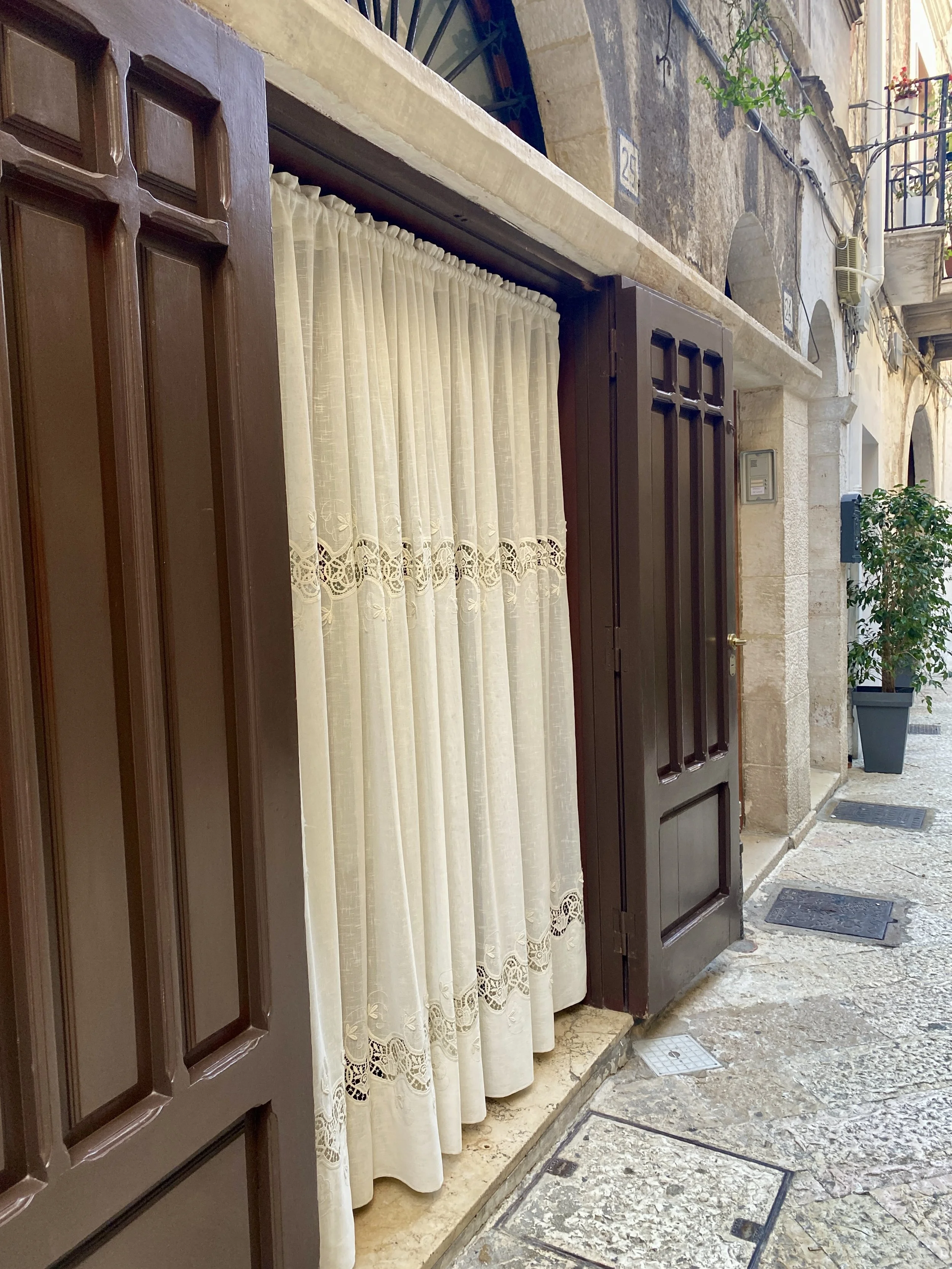
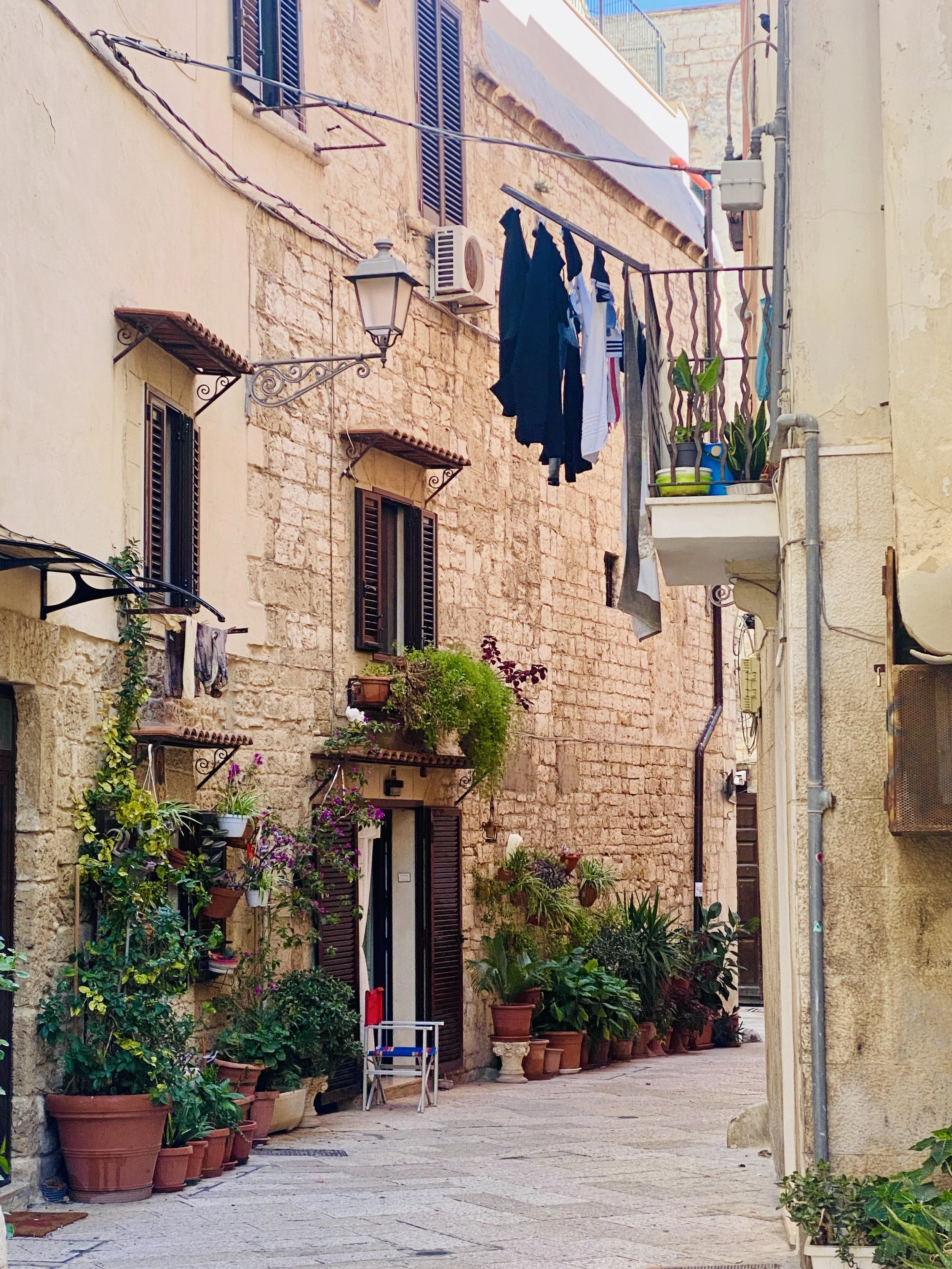
Front doors open directly onto the street, often shielded only by sheer curtains, and so the intimacy of daily life spills outward. Cutlery clinks. A music lesson stumbles into repetition. Voices rise. Televisions hum. Mops swish across blue tile floors (those Bari floors must get pretty dirty). Those peppers hit hot oil with a sizzle and snap. Fabric rustles as someone crosses from street to home.
Outside, bells chime—jangling and insistent like ankle bells on a stomping giant—sometimes within minutes of each other, raising the question of what, exactly, requires such constant heralding.
Add to this women gathered in chairs outside their homes, young and toothless alike, one of whom shouted at me to put on a jacket lest I freeze in seventy-degree weather. Men play cards down a set of steps thatpugl lead to a guild. Scooters whine into the distance.
Life hums, a full orchestra, carrying over the rooftops.
It was a melody I would have missed if I’d been pointing out boats to a companion or asking whether they liked their spaghetti all’assassina—the Bari dish cooked directly in tomato sauce until the starch crisps into shattering edges (check out this article by the Puglia guys for more, it’s also a great resource for the area).
Besides the constellation of sound, another difference between traveling alone in a big city like Paris and traveling alone in off-the beaten path Bari—alone in Bari, people talk to you.
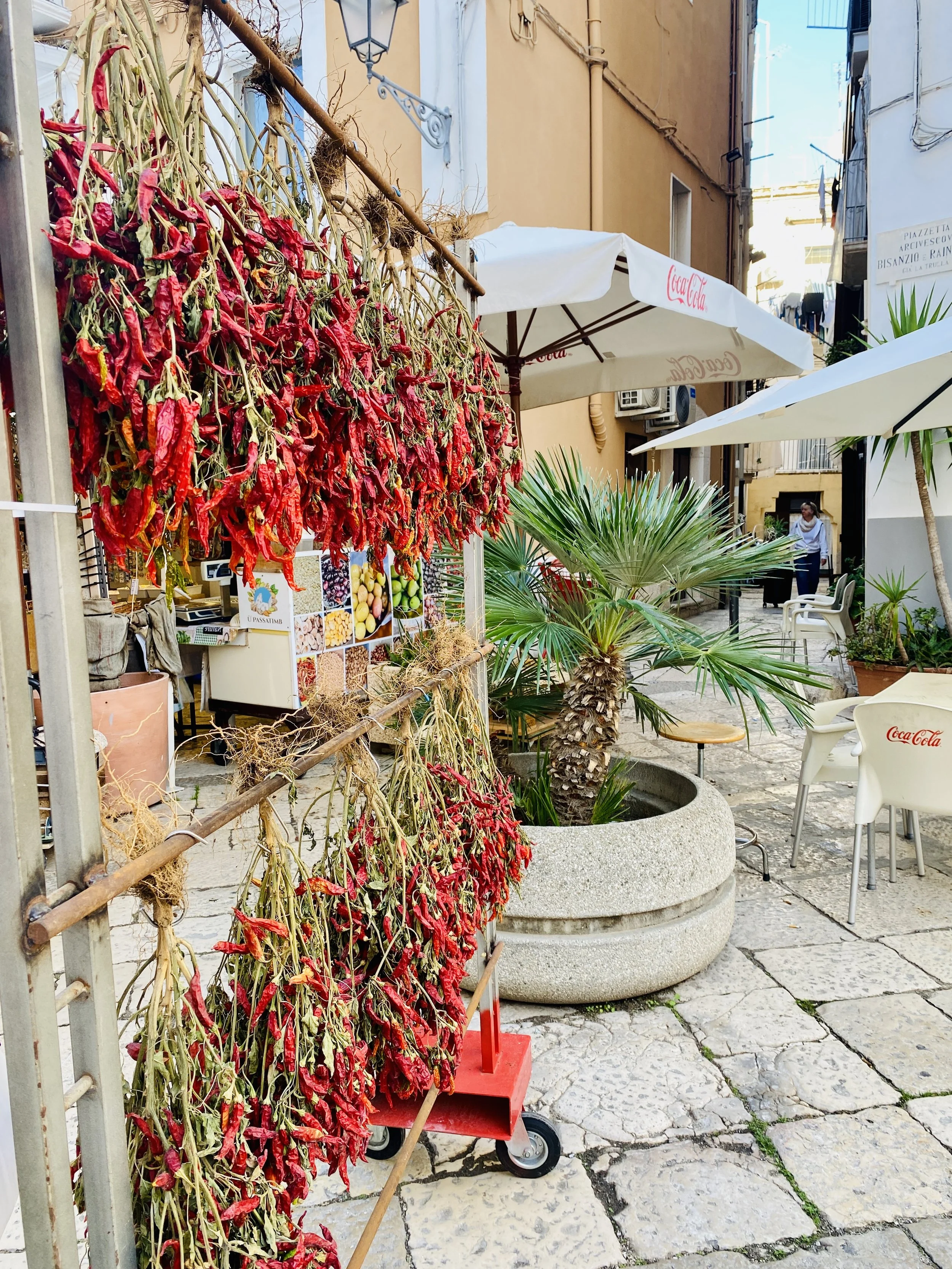
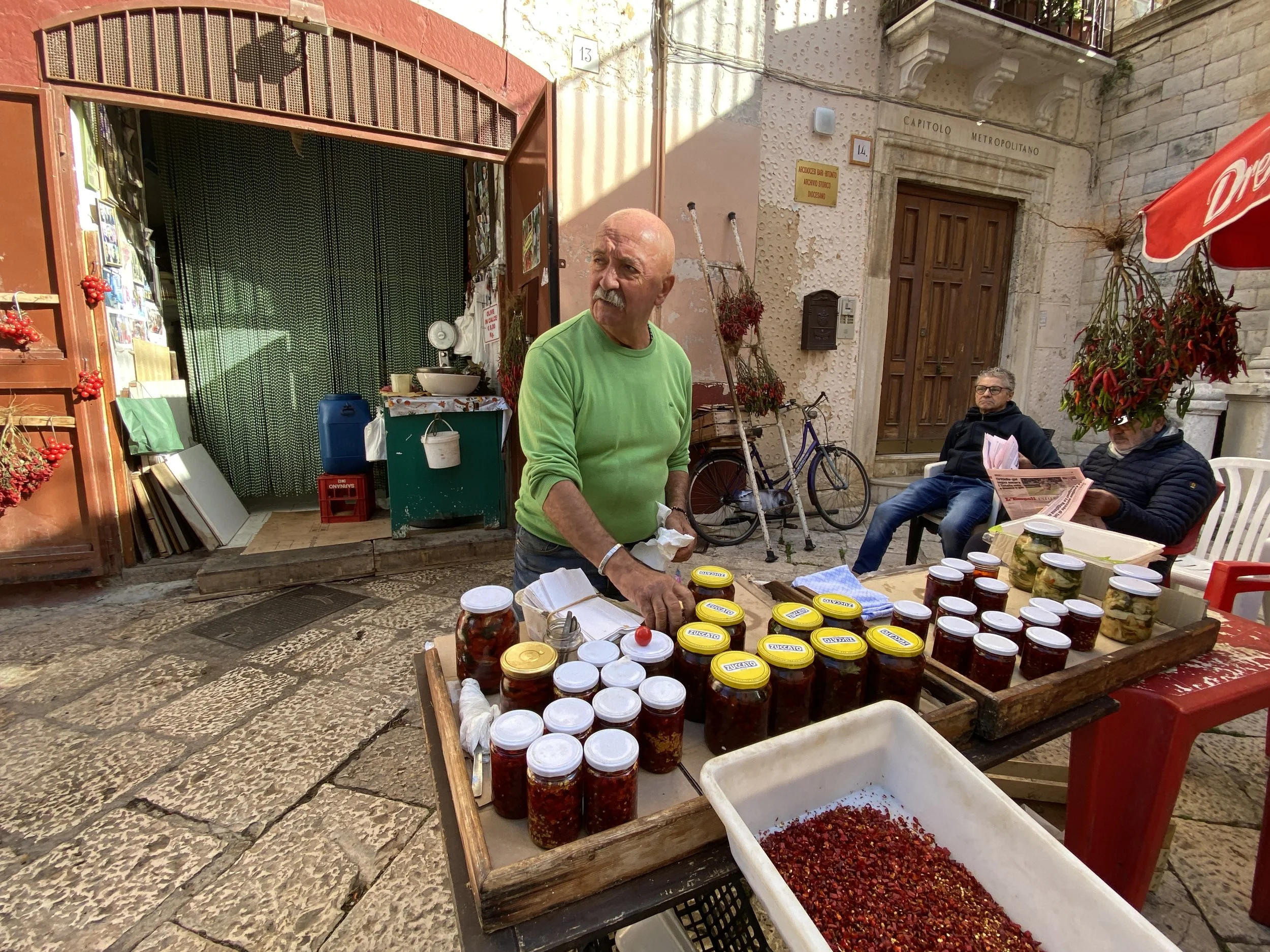
While taking a photo of drying peppers, a “shopkeeper” (quotes to indicate there was no shop, just a table outside what appeared to be his garage) asked if he could give me a taste. First a tiny sun-dried tomato preserved in oil. Then a pepper, when I asked if he had anything spicy. I chose the tomato, surprising him twice—once for my choice (the pepper was good, but the tomato was a thing apart), and again when he found out I was American.
As he wrapped up my jar of tomatoes in a little white plastic bag, he complimented my Italian and declared me a beautiful woman. I’d like the record to show that this was after he handed me my change.
I asked if I could take his photo and he said, “Fai, fai.” Literally “do, do” which I interpreted as “go ahead” and snapped a few as he pretended to straighten his jars as if I’d caught him unawares. You can check out my “candid” photo of him here.
I chuckled and as I walked away I thought about how different the conversation would have been if I’d been with people. I would have been more mute, that’s for sure, but the gentle regard of a one-on-one connection, that would have been absent altogether.
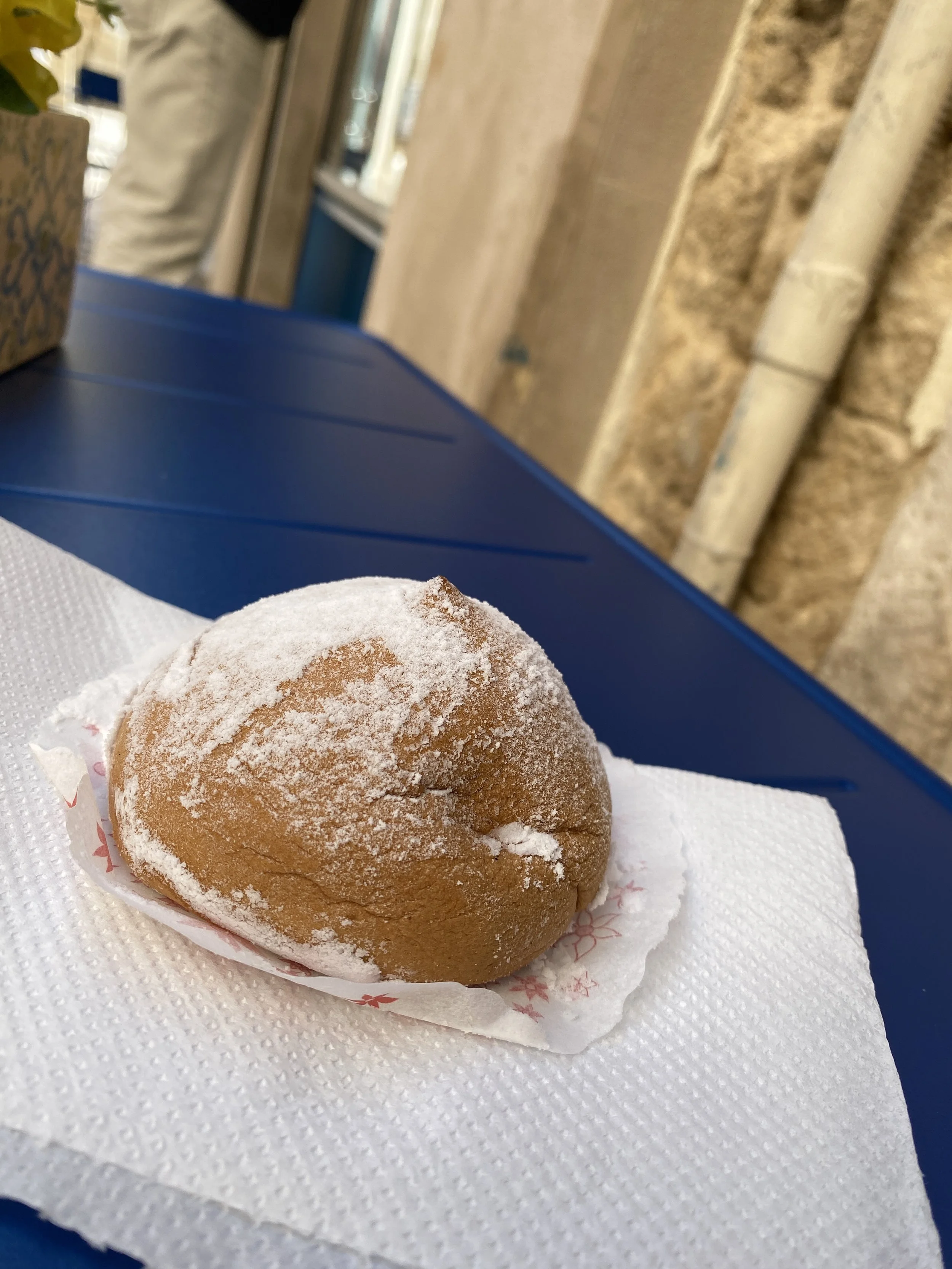
Later, I sought out a pastry my friend Mark had mentioned: tette delle monache. When he said it, I paused. “You can’t mean a boob.” Oh, but he did. It’s an exceedingly soft sponge cake filled with whipped cream and shaped exactly as advertised.
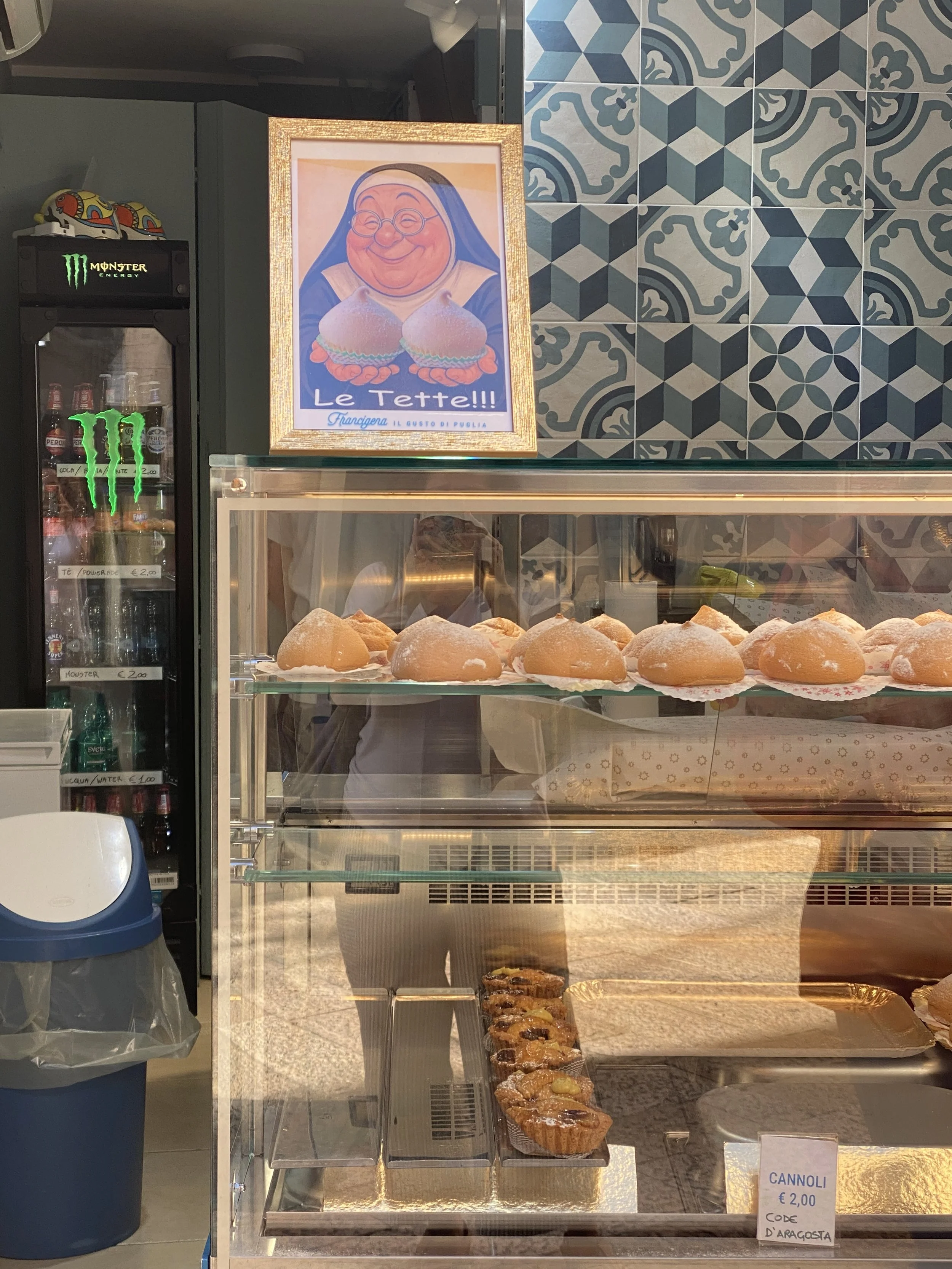
As I stood blushing slightly at the display, I noticed a couple signing to each other as they pointed to the case. Fascinating, I’d never seen deaf people communicating with each other in Italy.
I ordered my nun’s boob and asked if I might sit at the small table, to which the baker replied, “Come no?” One of my favorite Italian phrases. It means “why not,” but makes agreement sound philosophical.
As I tried not to wear the whipped cream, the man I’d seen signing ordered a pastry, wolfed it down in two bites, dabbed the corners of his mouth and turned to leave. When he passed me, he knocked on my table. When I looked up, he mouthed the word “buono” (good) while making the sign for “delicious”, a turning knuckle at the cheek. It’s actually a move I’ve seen often, which made me wonder how much Italian sign language blurs with Italian gesture.
I turned my knuckle at my cheek and we grinned at each other before he strode back to his wife.
The exchange filled me more than the pastry, though it was an awfully good pastry.
It should be noted that Bari excels in stands: peppers drying in the sun, bakers selling nun boobs, frying cubes of polenta at a busy street corner, and the best focaccia of my life—earned by waiting in a chaotic line outside Panificio Santa Rita, guarded by a literal bouncer. At one point the bouncer announced, well, I didn’t know what he announced, it sounded like if you don’t have a number yet, go home, we’re almost out of focaccia. I stayed, hoping and praying they’d have enough for when my number was called.
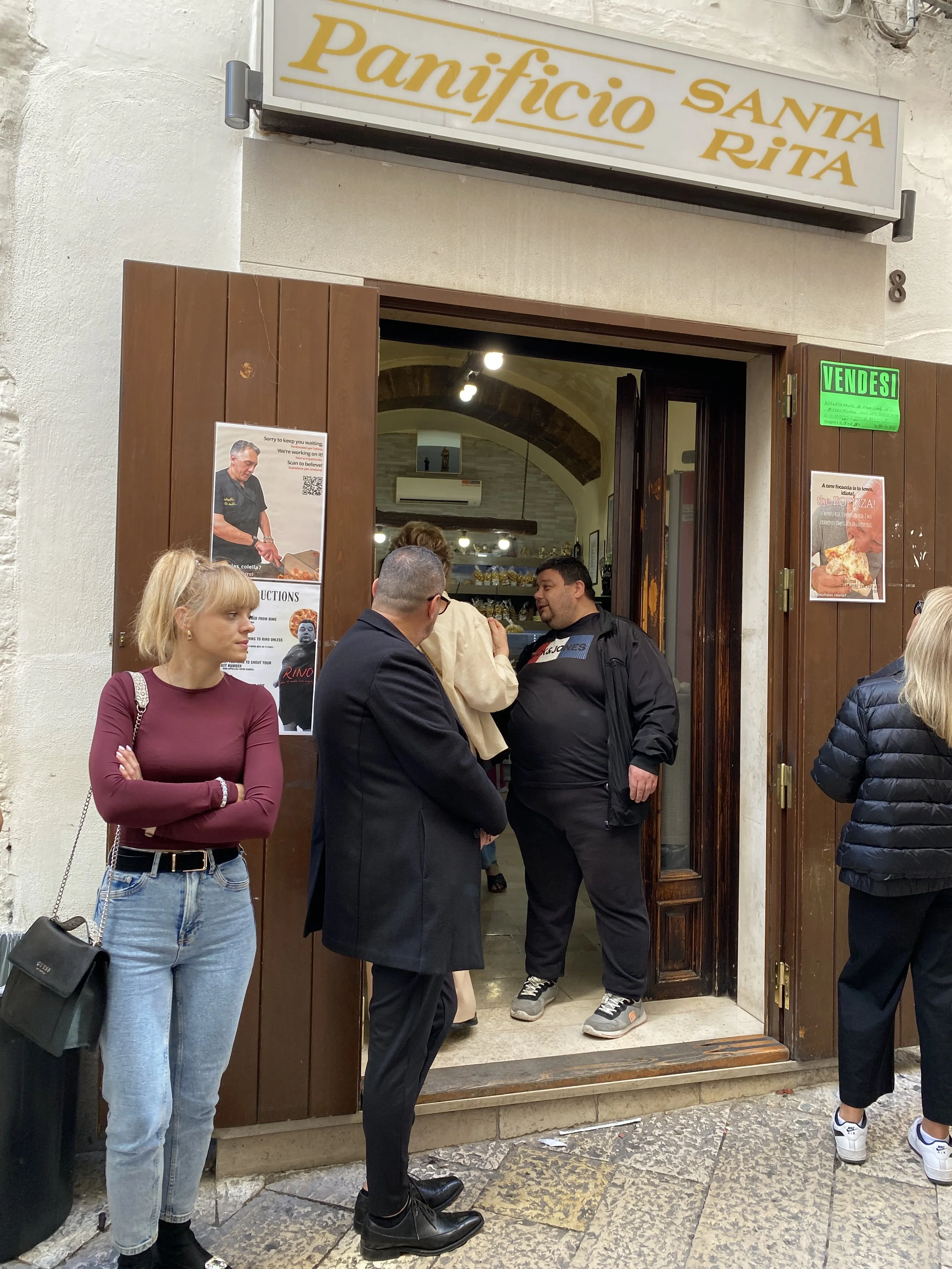
I texted my husband updates as if I were awaiting college admissions. He told me he hoped the focaccia was worth it. Not the cost, it was literally a euro, but the hours of waiting (it could have been 15 minutes actually—time loses meaning when you don’t entirely know what’s happening but you are surrounded by people yelling, “you’d send me back to my city without focaccia?”).
When my number was finally called, I took one bite of oil-crisped, impossibly soft focaccia topped with tomatoes, olives, and oregano…and had to hold onto the wall. Knees buckling. Eyes closed. The kind of focaccia that sends all of your previous ideas of focaccia skittering into the briny air like foam from a shaken octopus.
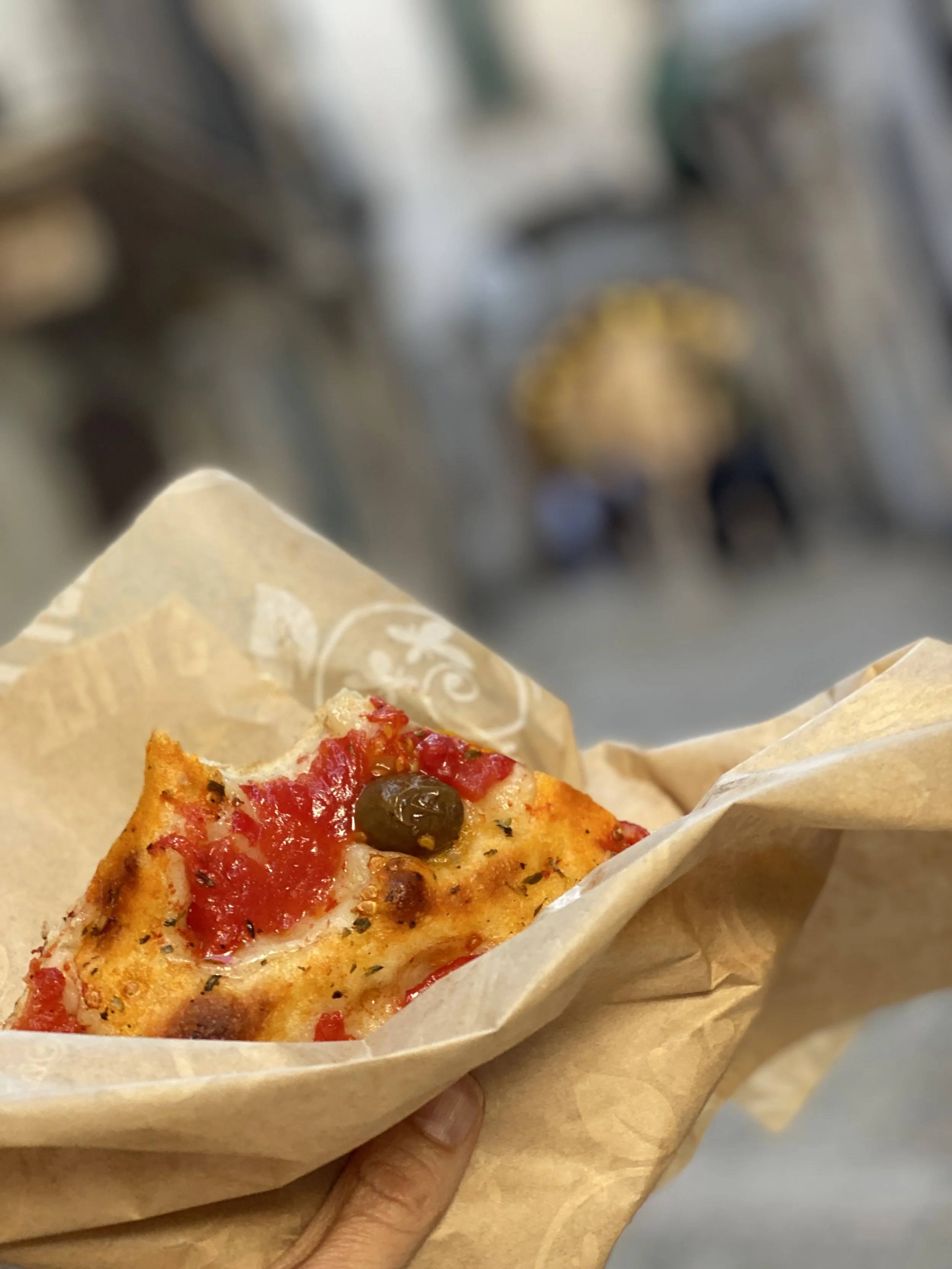
Which, I think, is what Bari did for me.
It reminded me that the places that stay with us are not the ones we rush through or even fully understand, but the ones we let speak to us—in their rhythms, their rough edges, their generosity. Sometimes through fish. Sometimes through sound. Sometimes through a single bite that makes time briefly lose all meaning.
If you’re interested in a trip to Bari, Italy, there are seasonal direct flights from JFK!
Want to discover more off-the-beaten-path Italy? Click the button below and I’ll instantly send you the Italian Hidden Gems Starter Kit, complete with practical information on five destinations most tourists miss. The kit includes when to go, what to eat, where to day trip, and MORE!